
Single page vs multi page websites: Which Structure is Best for SEO, Google Rankings and Business Growth?
Choosing the right website structure is one of the most important decisions you'll make when planning a new website. Whether you're launching a new business, replacing an outdated website or investing in a complete digital marketing strategy, the way your website is organised has a direct impact on how easily customers can find you online, how they interact with your content and how your business can grow over time.
One of the first questions many businesses ask is whether they need a single-page website or a multi-page website. While both approaches have their place, each offers distinct advantages depending on your goals, industry and marketing strategy.
A single-page website presents all of your content on one continuous page. Visitors simply scroll through different sections, such as your services, testimonials and contact information, without leaving the page. This approach is clean, simple and often very effective for businesses with a focused offering.
A multi-page website, by comparison, separates information into dedicated pages. Instead of placing everything on one page, you'll typically have individual pages for your services, about us, FAQs, case studies, blog articles and contact details. This structure gives search engines more content to index and provides visitors with a more organised browsing experience.
Neither option is automatically "better". The right choice depends on factors such as:
- The size of your business
- The number of products or services you offer
- Your long-term growth plans
- Your SEO objectives
- The level of competition within your industry
- How your customers prefer to find information
Many new businesses assume a one-page website will always be cheaper and easier, while larger organisations often believe they automatically need dozens of pages. In reality, there is no universal solution. The best website structure is the one that supports your customers' needs while helping search engines understand exactly what your business offers.
Throughout this guide, we'll compare both approaches in detail, explaining how each performs for search engine optimisation (SEO), user experience, website maintenance, lead generation and future scalability. By the end, you'll have a clear understanding of which website structure is most appropriate for your business today—and how it can continue supporting your growth in the years ahead.
Key Takeaway
A successful website isn't measured by the number of pages it contains. It's measured by how effectively it helps visitors find the information they need, encourages them to take action and demonstrates expertise to search engines.
What is a Single Page Website?
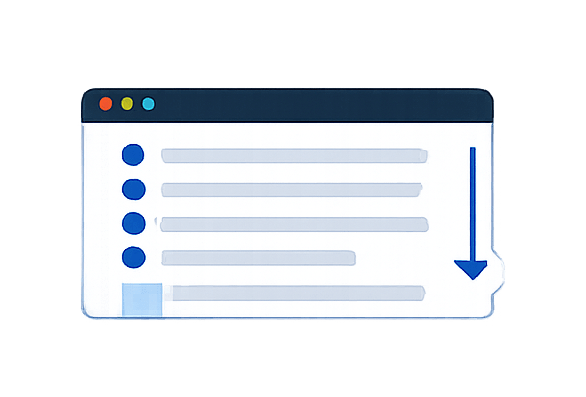
A single-page website presents all content on one continuously scrolling page.
Navigation links simply move visitors between sections rather than loading separate pages.
Common Uses
✔ Landing pages
✔ Personal portfolios
✔ Events & promotions
✔ Small businesses with a limited number of services
A single-page website (sometimes called a one-page website) contains all of its primary content on a single web page. Navigation links typically use smooth scrolling to move visitors between sections such as:
- Introduction
- About the business
- Services
- Portfolio
- Testimonials
- Frequently Asked Questions
- Contact form
This type of website has become increasingly popular with start-ups, consultants, tradespeople and businesses that only need to promote one primary service.
Because visitors remain on one page throughout their journey, the experience feels quick, modern and straightforward. Instead of navigating through menus, users simply scroll until they find the information they're looking for.
Advantages of a Single-Page Website
For many businesses, simplicity is its biggest strength.
A one-page website can usually be designed and launched more quickly than a larger website because there are fewer templates to create and less content to produce. Maintenance is often easier too, as updates can usually be made from one location.
Single-page websites also create a highly focused customer journey. With fewer navigation choices, visitors are guided naturally towards a single call to action, such as requesting a quote, booking a consultation or making an enquiry.
Other benefits include:
- Faster project completion
- Lower initial development costs
- Clear conversion-focused design
- Excellent mobile browsing experience
- Simple ongoing maintenance
- Consistent branding throughout the page
For businesses relying on paid advertising or social media campaigns, a single-page website can often function extremely well as a dedicated landing page designed around one objective.
Limitations of a Single-Page Website
While one-page websites have many advantages, they also have limitations that become increasingly apparent as a business grows.
The biggest challenge is search engine optimisation.
Search engines aim to match individual pages with specific user searches. When every service, product and topic appears on one page, it becomes much harder to optimise content for multiple search terms.
For example, a digital marketing agency may want to rank separately for:
- Website Design
- SEO Services
- Google Ads Management
- Social Media Marketing
- Local SEO
- Ecommerce Websites
Trying to optimise one page for all of these topics can dilute relevance and make it more difficult for search engines to understand which service is most important.
As your business develops, adding new services, case studies, blog articles or downloadable resources can also become challenging. A page that started at 1,000 words can quickly grow into a document exceeding 6,000 words, making navigation and content management increasingly difficult.
What is a Multi-Page Website?
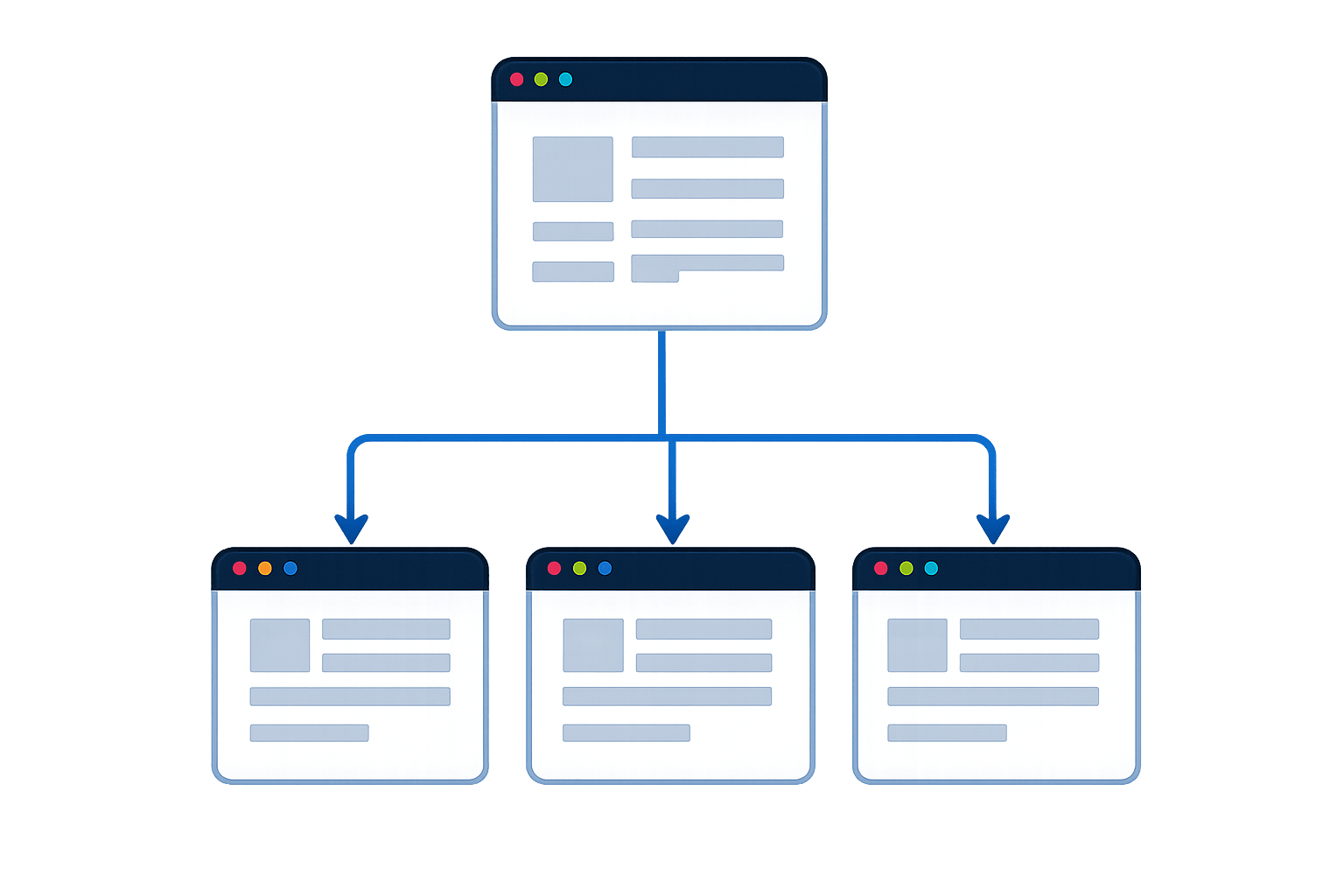
A multi-page website contains dedicated pages for each section of the business.
Typical pages include: Home, About, Services, Products, Blog and Contact
Each page has its own URL and can be individually optimised for search engines.
Common Uses
✔ Ecommerce websites
✔ Businesses offering multiple services
✔ Geographical targeting
✔ SaaS platforms
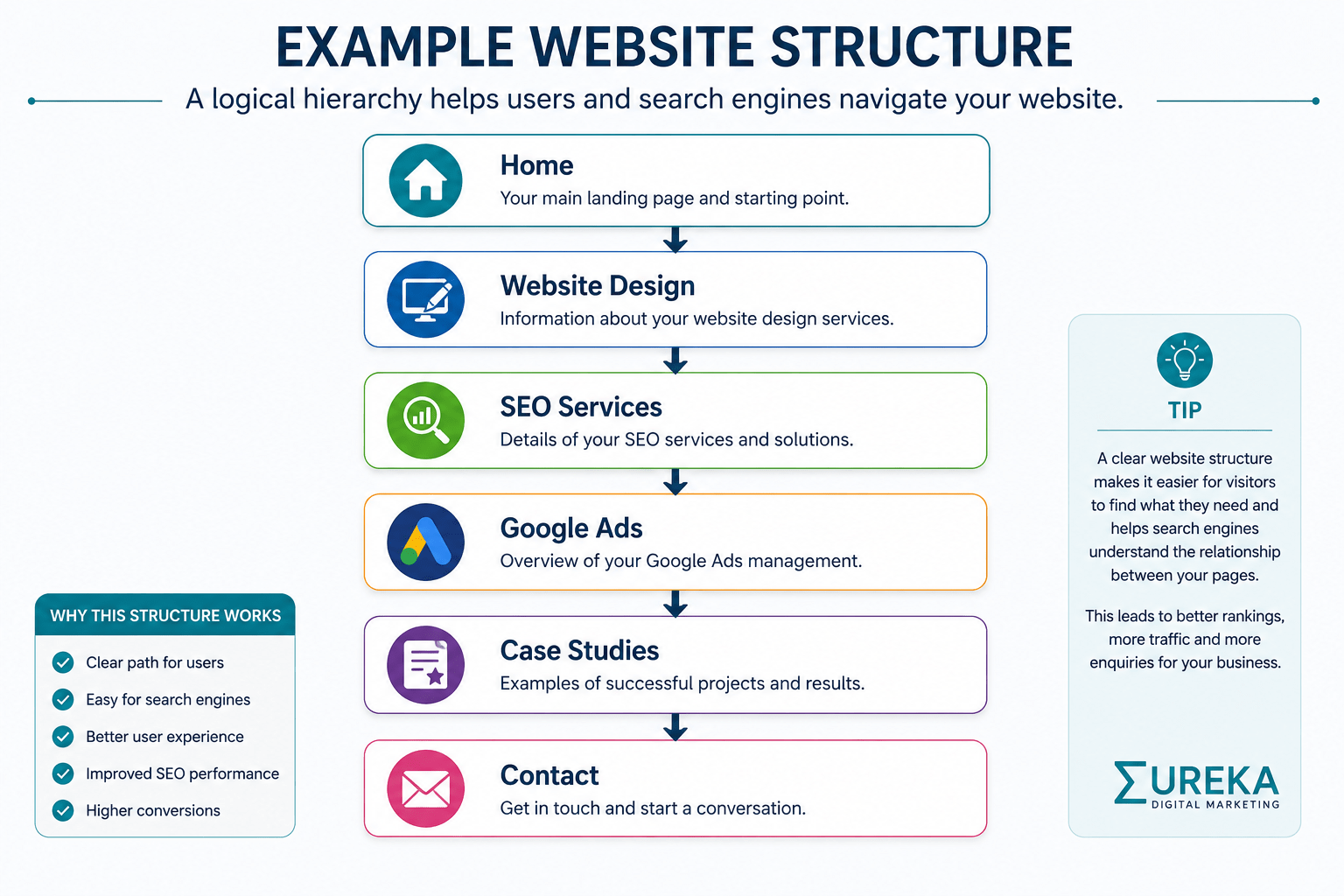
A multi-page website organises information into dedicated pages, creating a logical structure that is easy for both visitors and search engines to understand.
Rather than presenting everything on one page, each major topic has its own destination. A typical business website might include:
- Home
- About Us
- Website Design
- SEO Services
- PPC Advertising
- Case Studies
- Blog
- FAQs
- Contact
Each page focuses on a single subject, allowing content to be written in greater depth and optimised for relevant keywords. This creates a stronger topical structure that benefits both usability and long-term SEO.
Think of your website as your digital premises. A single-page website is like a well-designed showroom, while a multi-page website is a complete business headquarters with dedicated rooms for every service, customer question and stage of the buying journey.
Advantages of a Multi-Page Website
The greatest strength of a multi-page website is flexibility.
Every service can have its own landing page, allowing businesses to answer customer questions in more detail, showcase examples of previous work and build trust through testimonials and case studies.
From an SEO perspective, this creates significantly more opportunities to rank in Google. Each page can target a different search intent while supporting related pages through internal linking.
For example, a Website Design page can naturally link to pages covering SEO, Website Hosting and Ongoing Support, helping both visitors and search engines discover related content.
As your business grows, new sections can be added without disrupting the existing structure. Whether you launch additional services, expand into new locations or begin publishing educational content, your website remains organised and easy to navigate.
Limitations of a Multi-Page Website
A larger website requires more planning.
Developing multiple pages takes longer than producing a single-page site, and creating high-quality content for every service requires a greater investment of time. Ongoing maintenance also becomes more important, as each page should be reviewed periodically to ensure information remains accurate and relevant.
However, for businesses that rely on Google search, these additional pages often become valuable long-term marketing assets that continue attracting visitors long after the website has been launched.
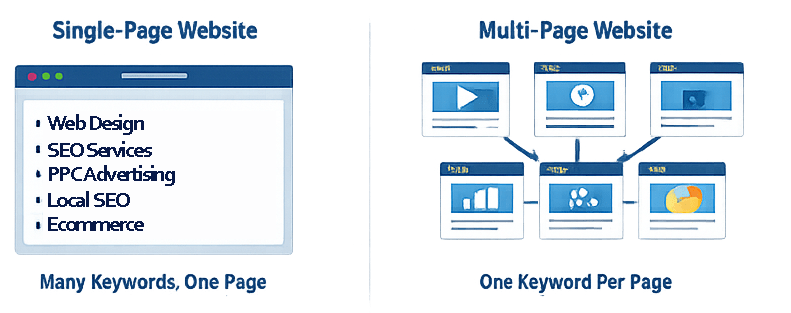
Single Page vs Multi-Page Websites: Which Performs Better for SEO?
Search engine optimisation (SEO) is one of the biggest factors influencing the choice between a single-page and multi-page website. While design and branding play an important role in creating a professional online presence, your website also needs to be easily understood by search engines such as Google.
Many business owners ask us whether Google prefers one-page websites or multi-page websites. The simple answer is Google does not favour either format by default. Instead, it rewards websites that provide the most useful, relevant and trustworthy answer to a user's search.
The challenge is that a multi-page website usually provides far more opportunities to demonstrate expertise across a wide range of topics.
SEO Pros & Cons
Single Page Website
Advantages
✔ Simple user experience
✔ Fast loading when well optimised
✔ Easy to build
✔ Excellent for focused campaigns
Disadvantages
✖ Search engines have only one page to index
✖ Difficult to target multiple keywords
✖ Lower opportunity to rank for numerous searches
✖ Limited content depth
✖ Analytics can become harder to interpret
Multi-Page Website
Advantages
✔ Easier for Google to crawl
✔ Every page targets different keywords
✔ More opportunities to rank
✔ Strong internal linking
✔ Better performance tracking
✔ Scales as the business grows
Disadvantages
✖ Takes longer to build
✖ Requires more ongoing content
✖ Navigation can become more complex
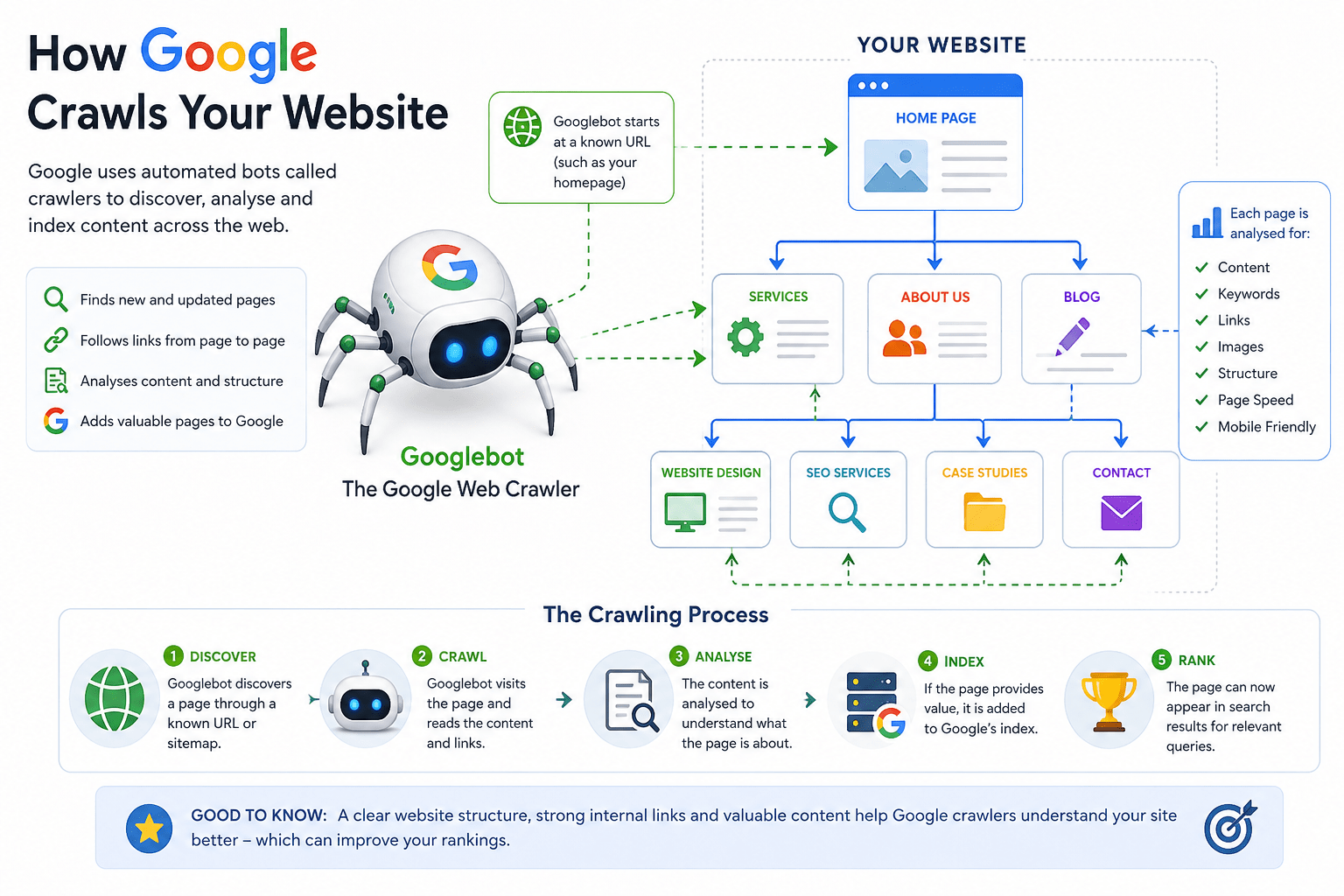
How Google Understands Your Website
Google doesn't "read" a website in the same way a person does.
Instead, Google's automated crawlers discover pages, follow links, analyse headings, interpret content and build an understanding of how every page relates to another.
Think of Google as creating a giant map of your website.
The clearer that map becomes, the easier it is for Google to decide:
- What your business does
- Which services you offer
- Which pages answer particular search queries
- Which content deserves to rank highest
A well-structured multi-page website naturally creates this map:
Google immediately understands that every page has a specific purpose while still belonging to the same business.
A single-page website, however, contains every topic on one URL.
Although Google is perfectly capable of indexing long pages, it becomes much harder to associate individual sections with highly specific searches
How website structure impacts SEO
Crawlability
Search engines need to discover your pages before they can rank them.

Indexing
Each page added to Google's index increases ranking opportunities.

relevance
Dedicated pages allow highly relevant content for specific searches.
Rankings
The more relevant and authoritative your content is, the better it can rank.
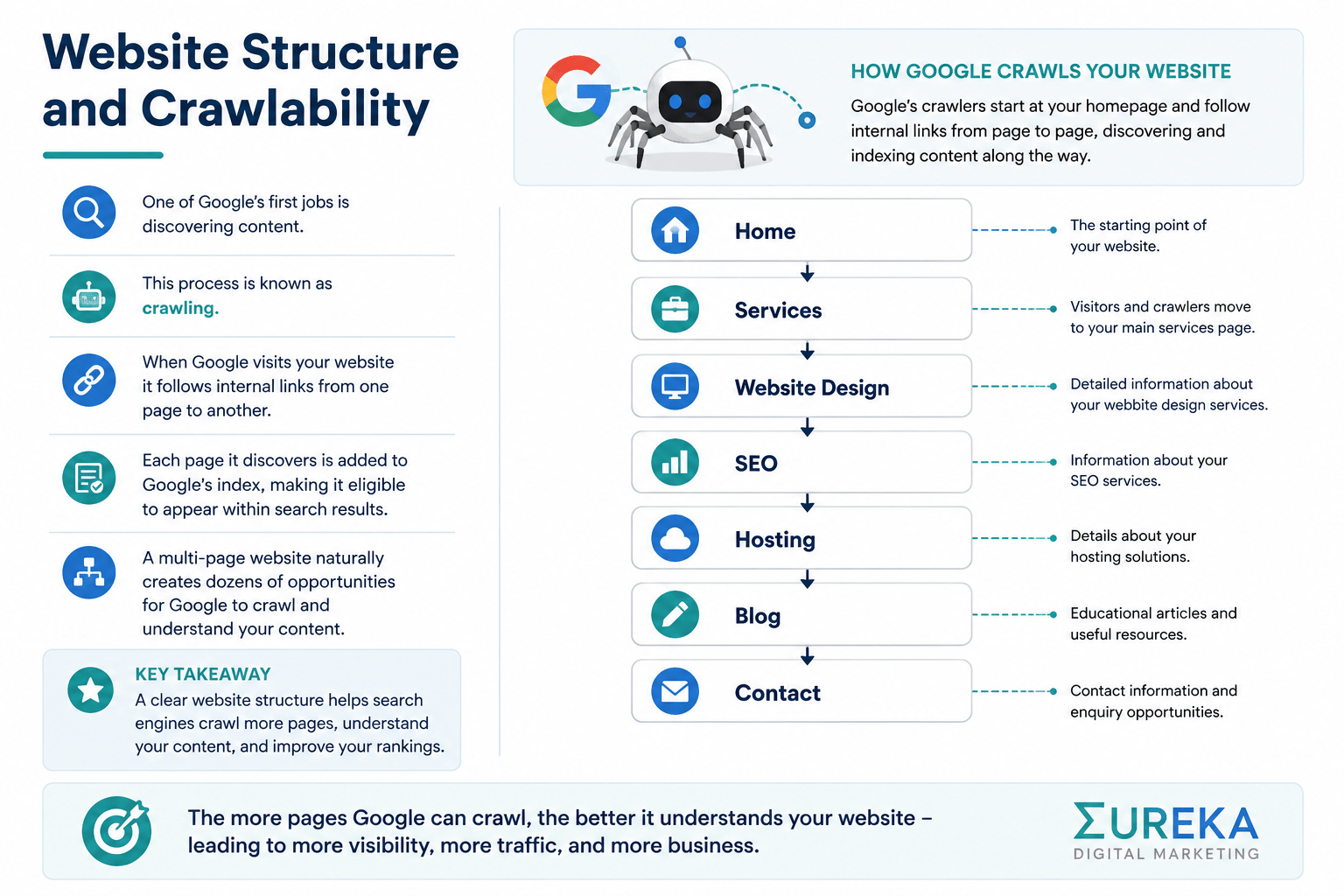
Website Structure and Crawlability
One of Google's first jobs is discovering content.
This process is known as crawling.
When Google visits your website it follows internal links from one page to another.
Each page it discovers is added to Google's index, making it eligible to appear within search results.
A multi-page website naturally creates dozens of opportunities for Google to crawl and understand your content.
Each page becomes another doorway into your business.
Someone searching for:
Website Design Surrey
may land directly on your Website Design page.
Someone searching for
What is Local SEO?
may arrive via your SEO page.
Someone researching
How much does a business website cost?
may discover one of your blog articles.
This flexibility simply isn't available when every topic exists on a single page.
Single page website
Single page website
Single page website

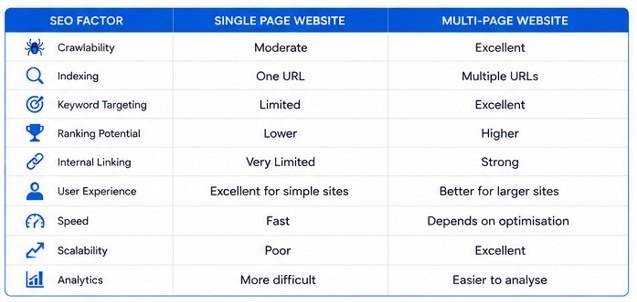
Crawlability
Moderate
Excellent

Indexing
One URL
Multiple URL's
Keyword Targeting
Limited
Excellent

Ranking Potential
Lower
Much Higher
Crawlability
Very Limited
Strong
User Experience
Good for small sites
Much better for larger sites
Speed
Can be fast
Depends on optimisation

Scalability
Poor
Excellent
Analytics
More difficult
Easier to analyse
Keyword Targeting
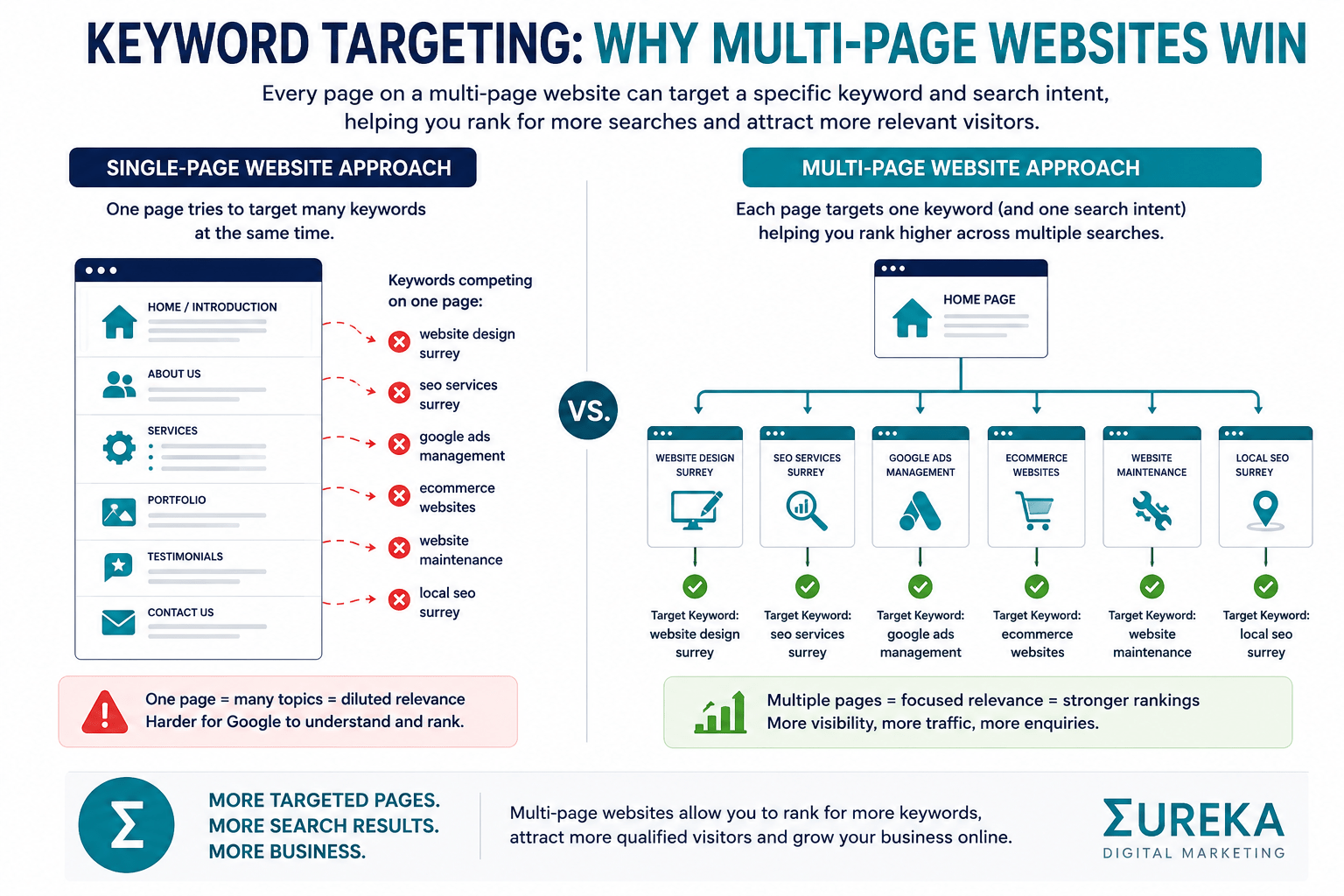
One of the biggest advantages of a multi-page website is keyword targeting.
Each page should focus on one primary topic.
For example:
| Page | Primary Keyword |
|---|---|
| Home | Digital Marketing Agency |
| Website Design | Website Design Surrey |
| SEO | SEO Services Surrey |
| PPC | Google Ads Management |
| Ecommerce | Ecommerce Website Design |
| Blog | Long-tail informational keywords |
Because every page has its own:
- Title
- Meta Description
- URL
- Heading Structure
- Images
- Internal Links
Google receives far clearer signals about what each page should rank for.
A single-page website has only one page title, one URL and one primary focus.
Although headings can still help organise content, you're asking one page to compete for many unrelated searches.
This often reduces your ability to rank strongly for competitive keywords.
Building Topical Authority
Google increasingly rewards websites that demonstrate expertise within a particular subject.
This is often referred to as topical authority.
Imagine someone searching for information about website design.
Which business appears more authoritative?
Website A
• One page
• 1,500 words
Website B
• Website Design page
• SEO page
• Hosting page
• Maintenance page
• Case Studies
• FAQs
• 40 educational blog articles
For Google, Website B demonstrates significantly broader knowledge.
Every article strengthens the others.
Every internal link reinforces the overall topic.
Over time, this creates a website that becomes increasingly trusted within its specialist area.
Internal Linking
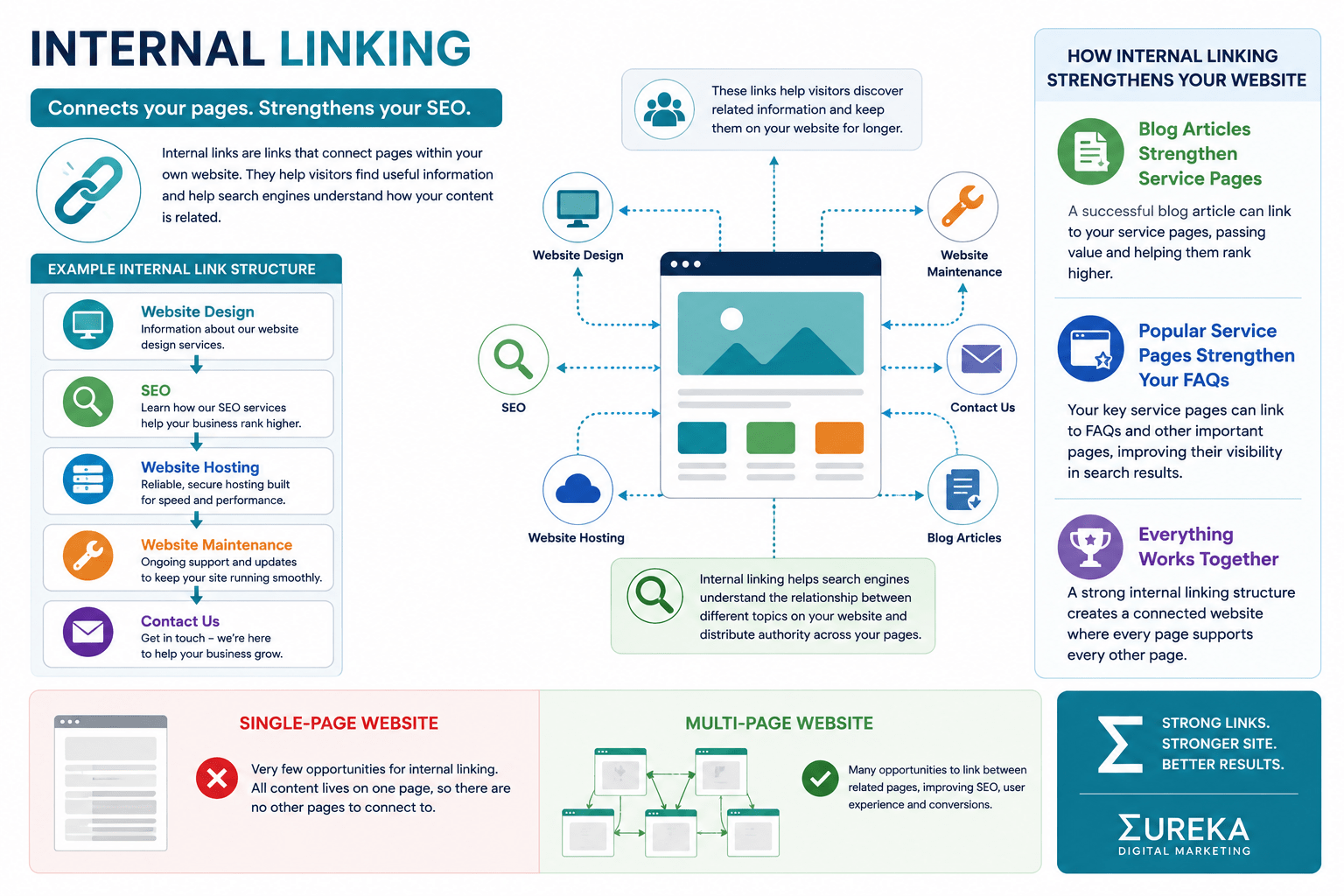
Internal links are one of the most overlooked aspects of SEO.
These are links that connect pages within your own website.
These links help visitors discover related information while also helping Google understand the relationship between different topics.
Internal linking distributes authority around your website.
A successful blog article can strengthen your service pages.
A popular service page can strengthen your FAQs.
Everything works together.
A single-page website contains very few opportunities for meaningful internal linking because there are no additional pages to connect.
If your website currently consists of a single page but your business is growing, it may be time to consider expanding into a multi-page structure. Dedicated service pages, educational articles and case studies not only improve the visitor experience but also create more opportunities to rank for valuable search terms.
At Eureka Digital Marketing, we build websites with long-term growth in mind. Every page is planned to support SEO, encourage enquiries and provide a solid foundation for future content marketing.
Get in touch
Let’s Talk About Growing Your Business
Struggling to get found on Google? Send us a few details and we’ll help you understand the best SEO route for your business.. To arrange a meeting, fill the form in below and a member of the team will get in touch with you, alternatively you can book a time slot at a time that suits you by clicking this link, or simply call us on 01276 582169
Tell us a little about your goals and we'll be in touch within one working day.