
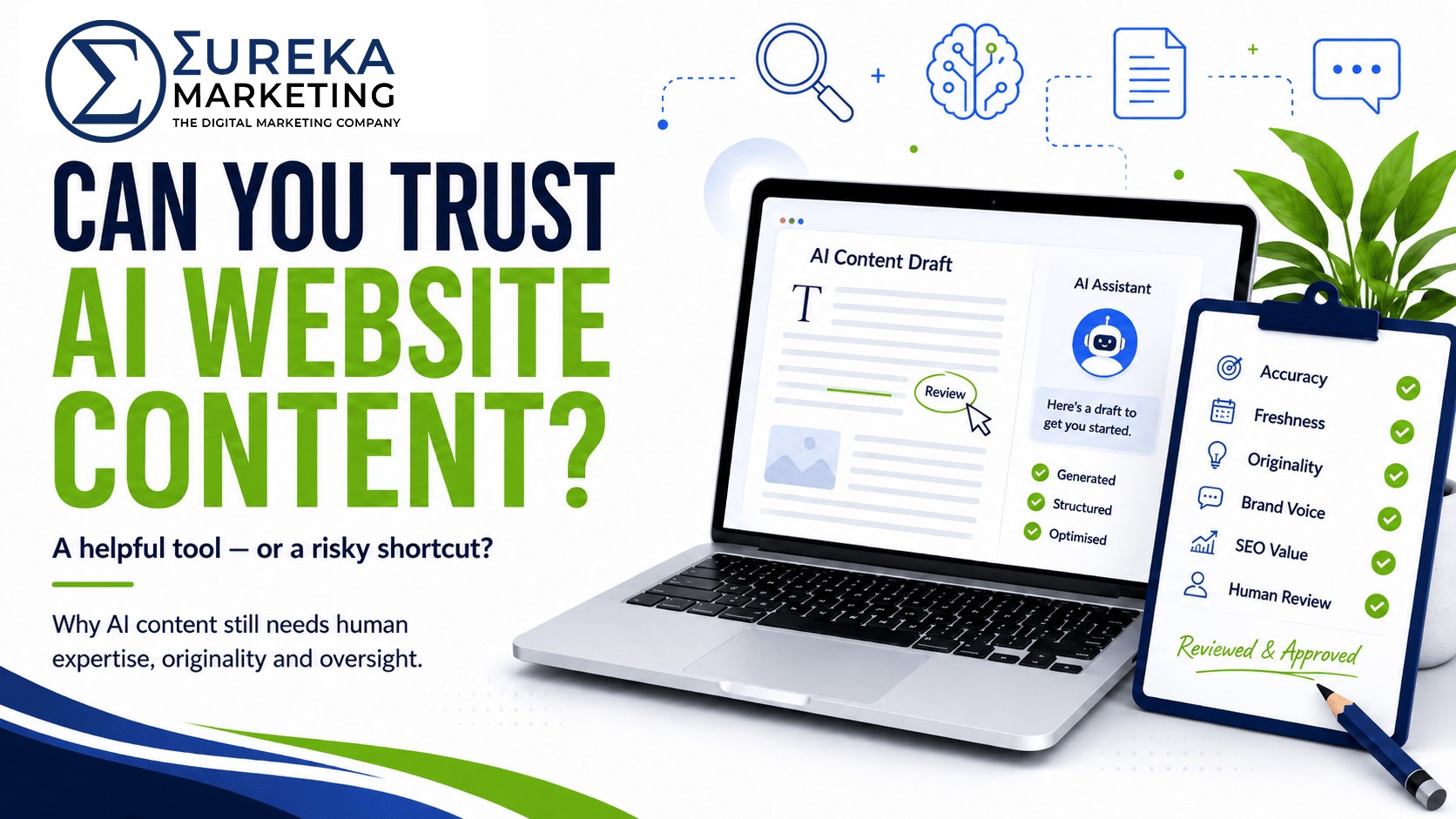
AI Website Content: Helpful Tool or Risky Shortcut?
Artificial intelligence is now appearing everywhere in marketing. From chatbots and content assistants to website agents that promise to write blogs, landing pages and social media posts automatically, it can feel like AI is becoming the answer to everything.
But when it comes to website content, there is one very important question businesses should be asking:
Where is the content actually coming from?
At Eureka Marketing we believe AI can be a useful tool when used properly. It can help with ideas, structure, research, first drafts and content planning. However, it should not replace strategy, human judgement, industry knowledge or original thinking.
Because content is not just words on a page. Good content needs to be accurate, useful, relevant, trustworthy and valuable to the people reading it.
The problem with automatic AI content
There are now plenty of AI agents that can sit on a website and claim to produce content automatically. On the surface, this sounds brilliant. More content, less time, lower cost.
But the real question is not whether AI can write content.
The real question is whether that content is any good.
Many AI tools create content by drawing from large amounts of existing information. Depending on the tool, that information may come from training data, live web searches, your own website, uploaded documents, or publicly available online content.
That creates a few important issues.
Is the information accurate?
Is it up to date?
Is it original?
Is it based on your business?
Is it saying anything your competitors are not already saying?
And, importantly, does it add any real value?
If the answer is no, then AI content can quickly become thin, generic and forgettable.
Fresh content is not just “new words”
One of the biggest misunderstandings around AI content is the idea that because the text is newly generated, the content must be fresh.
That is not always the case.
AI can create a new article using old information. It can rewrite common points that already exist across dozens of websites. It can produce something that sounds polished, but still lacks insight, originality and relevance.
For content to be genuinely fresh, it should include real and current knowledge, such as:
recent customer questions, updated services, new case studies, changing industry trends, current pricing, local information, new project examples, recent reviews, and first-hand experience.
That is the type of content search engines and customers are more likely to value.
A blog that simply repeats what is already online is unlikely to make a business stand out.
Will Google penalise AI content?
Google does not automatically penalise content just because AI has been used. The bigger issue is quality.
Google wants to reward helpful, reliable, people-first content. That means content should be written to help the reader, not simply to fill a website with more pages.
The risk comes when businesses use AI to produce lots of low-value content at scale. If a website starts publishing generic AI-written pages that do not offer anything original or useful, it may struggle to perform well in search.
In simple terms, AI is not the problem.
Poor content is the problem.
What about copyright?
This is another area businesses need to think about carefully.
AI tools are trained on large amounts of information, and there is ongoing debate around how much of that information should be allowed to come from copyrighted work. Around the world, publishers, writers, artists and media companies are increasingly challenging how AI companies use their content.
Over time, it is very likely that content ownership, licensing and permissions will become a much bigger part of the AI conversation.
We may see more restrictions on how AI tools access content. We may also see more licensing agreements where AI companies have to pay to use high-quality information from publishers, news organisations and specialist content creators.
For businesses, this means one thing: do not assume all AI-generated content is automatically safe, original or free from risk.
The safest approach is to make sure your content is based on your own knowledge, your own services, your own experience and your own point of view.
The best use of AI in content marketing
AI can be incredibly helpful when used in the right way.
It can help you:
Plan blog topics, structure articles, generate FAQs, improve readability, create meta titles and descriptions, summarise research, turn notes into draft content, and repurpose existing material.
But it should still be guided by a human.
The best content will usually come from combining AI efficiency with real business insight.
That means using AI to support the process, while making sure the final content reflects your brand, your audience, your expertise and your goals.
Why human expertise still matters
Customers do not just want information. They want confidence.
They want to know that the business they are dealing with understands their problem, has experience solving it, and can be trusted.
That is difficult to achieve with generic AI content.
Strong content often comes from real conversations, real client questions, real project experience, real challenges and real results. These are the details that make content feel credible.
For example, a business can write a generic blog about “why website design matters.” But a stronger article might explain what actually happens when a business launches a new website without thinking about SEO, user experience, page speed, tracking or conversion journeys.
That type of content is more useful because it is based on experience.
Our view at Eureka Marketing is
We do not believe businesses should ignore AI.
Far from it.
AI is already changing marketing, and used well, it can save time, improve planning and support better content production.
But we also do not believe businesses should hand over their website content to an automated tool and hope for the best.
Your website is often the first impression people have of your business. It should communicate who you are, what you do, why you are different, and why someone should trust you.
That requires more than automatically generated words.
It requires strategy, creativity, accuracy and a clear understanding of your audience.
Final thought
AI can help create content faster.
But faster does not always mean better.
The businesses that benefit most from AI will be the ones that use it wisely: as a tool to support better thinking, not as a shortcut to replace it.
Great content still needs human insight, real experience and a clear purpose.
That is what makes it valuable.