
User Experience, Business Growth and Choosing the Right Website Structure
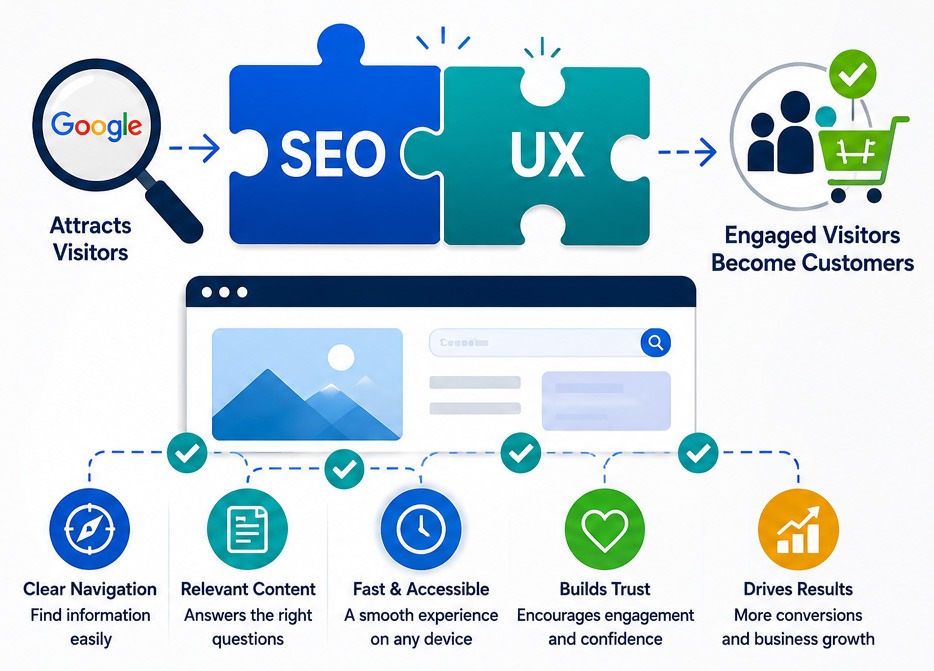
Search engine optimisation is only one piece of the puzzle. Once visitors arrive on your website, they need to find the information they're looking for quickly and easily. This is known as User Experience (UX), and it plays a vital role in determining whether a visitor becomes a customer.
Google increasingly measures how people interact with websites. If visitors struggle to find information, become frustrated by confusing navigation or leave without engaging, it can indicate that the website is not meeting user expectations.
The best website structures are designed around how customers think, not simply how businesses organise their services.
Single-Page UserJourney
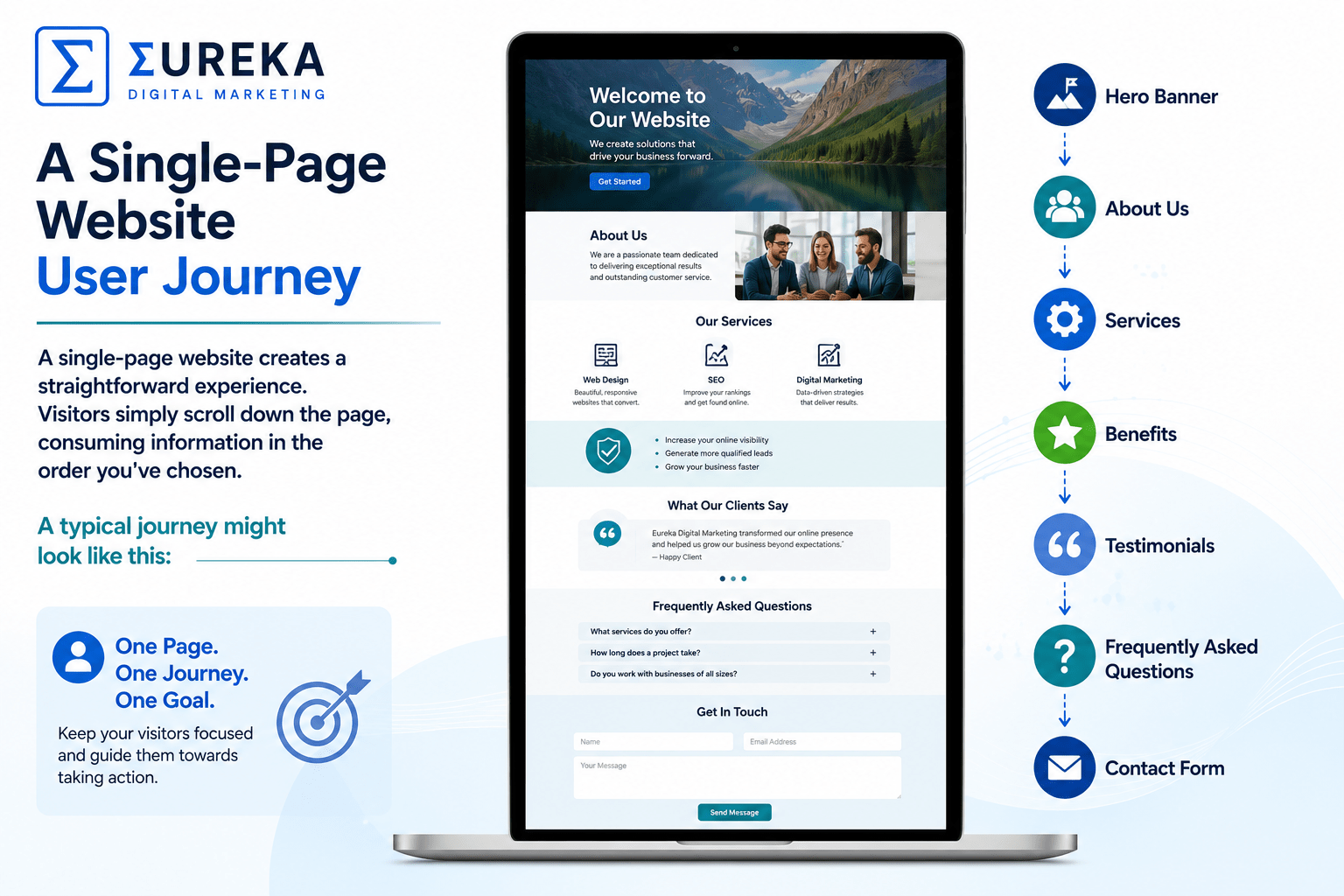
A single-page website creates a straightforward experience. Visitors simply scroll down the page, consuming information in the order you've chosen.
Everything flows naturally towards one goal.
This works particularly well when visitors only need a brief overview before making an enquiry.
Typical examples include:
- Electricians
- Plumbers
- Garden Designers
- Personal Trainers
- Freelance Consultants
- Event Promotion
- Product Launches
For these businesses, removing navigation choices can actually improve conversion rates because visitors remain focused on a single call to action.
Multi-Page User Journey
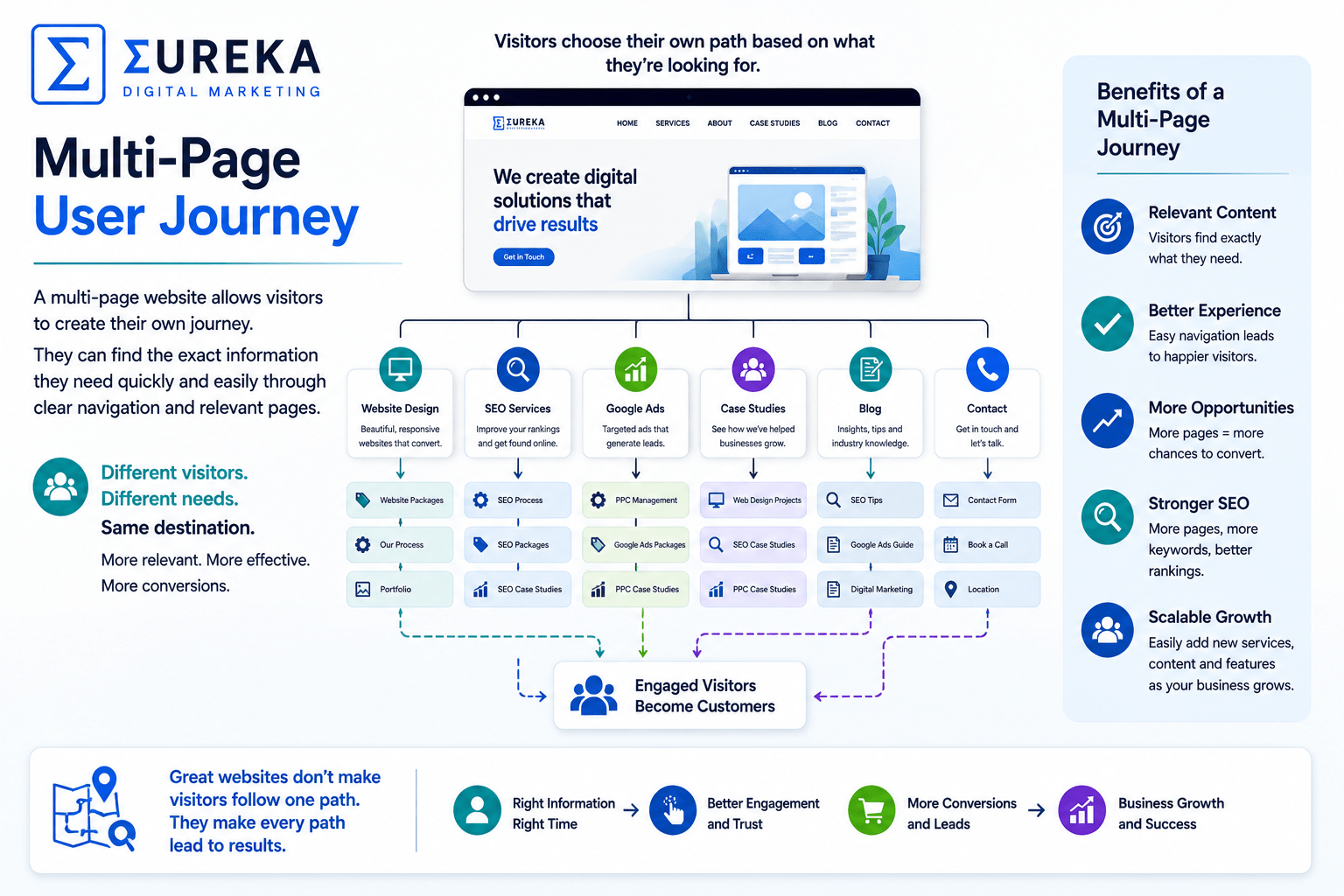
A larger business usually serves visitors with very different requirements.
One visitor may want pricing, another wants examples of previous work.
Someone else wants to understand your SEO process, another simply wants your contact details.
Trying to satisfy every visitor with one long scrolling page can quickly become overwhelming.
Instead, a multi-page website allows every visitor to create their own journey.
Each visitor reaches the same destination, but through content that's directly relevant to their needs.
Great website design isn't about making visitors follow one journey—it's about making it effortless for every visitor to find their journey.
Website Speed and Performance
One of the most common myths surrounding website design is that single-page websites are always faster.
The truth is more nuanced.
A lightweight one-page website with minimal imagery may load extremely quickly.
However, as businesses continue adding sections, testimonials, FAQs, animations, videos and galleries, the page becomes increasingly large.
Eventually visitors may be downloading:
- Every image
- Every animation
- Every testimonial
- Every FAQ
- Every service
...even if they only wanted your phone number.
A well-built multi-page website only loads the information required for the page the visitor is viewing.
Modern optimisation techniques such as:
- Lazy Loading
- Image Compression
- Browser Caching
- Content Delivery Networks (CDNs)
- WebP Images
mean multi-page websites often perform just as well—or even better—than large one-page websites.
Conversion Optimisation
The purpose of most business websites isn't simply attracting visitors.
It's generating enquiries.
Every page should encourage visitors to take the next logical step.
This process is called Conversion Rate Optimisation (CRO).
Single-page websites usually rely upon one prominent call to action repeated throughout the page.
For example:
- Request a Quote
- Call Today
- Book Consultation
Multi-page websites create significantly more conversion opportunities:
- Every page becomes its own landing page.
- Every service can have a tailored message.
- Every enquiry feels more relevant.
Mobile User Experience
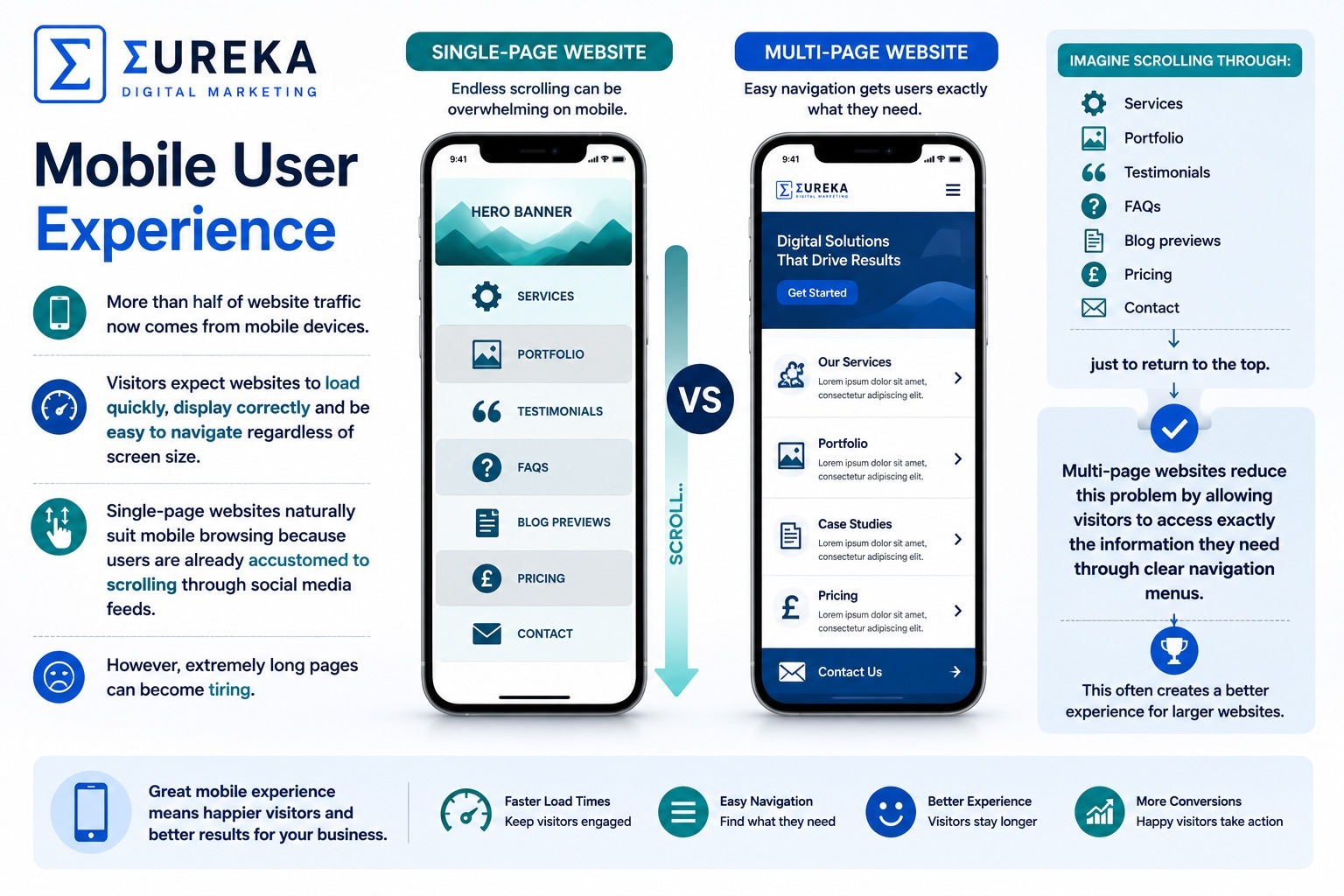
More than half of website traffic now comes from mobile devices., visitors expect websites to load quickly, display correctly and be easy to navigate regardless of screen size.
Single-page websites naturally suit mobile browsing because users are already accustomed to scrolling through social media feeds, However, extremely long pages can become tiring.
Accessibility
Website accessibility ensures everyone—including visitors with disabilities—can use your website effectively.
A clear page structure helps:
- Screen readers
- Keyboard navigation
- Visual hierarchy
- Heading structure
- Colour contrast
Smaller websites can be highly accessible.
Larger websites simply require greater planning.
Regardless of website size, accessibility should never be treated as an afterthought.
Not only is it good practice, but it also improves usability for every visitor.
Planning for Future Growth
Perhaps the biggest advantage of a multi-page website is scalability.
Businesses rarely stand still.
Today's website may contain:
- Home
- About
- Services
- Contact
Next year you may add:
- Case Studies
- Team Profiles
- Careers
- Resources
- Blog
- FAQs
- Downloads
Three years later you may require:
- Multiple office locations
- Industry landing pages
- Ecommerce
- Customer Portal
- Knowledge Base
A multi-page website grows naturally alongside your business.
By contrast, continually extending a single-page website often results in a page that's difficult to navigate and increasingly challenging to maintain.
Cost Comparison
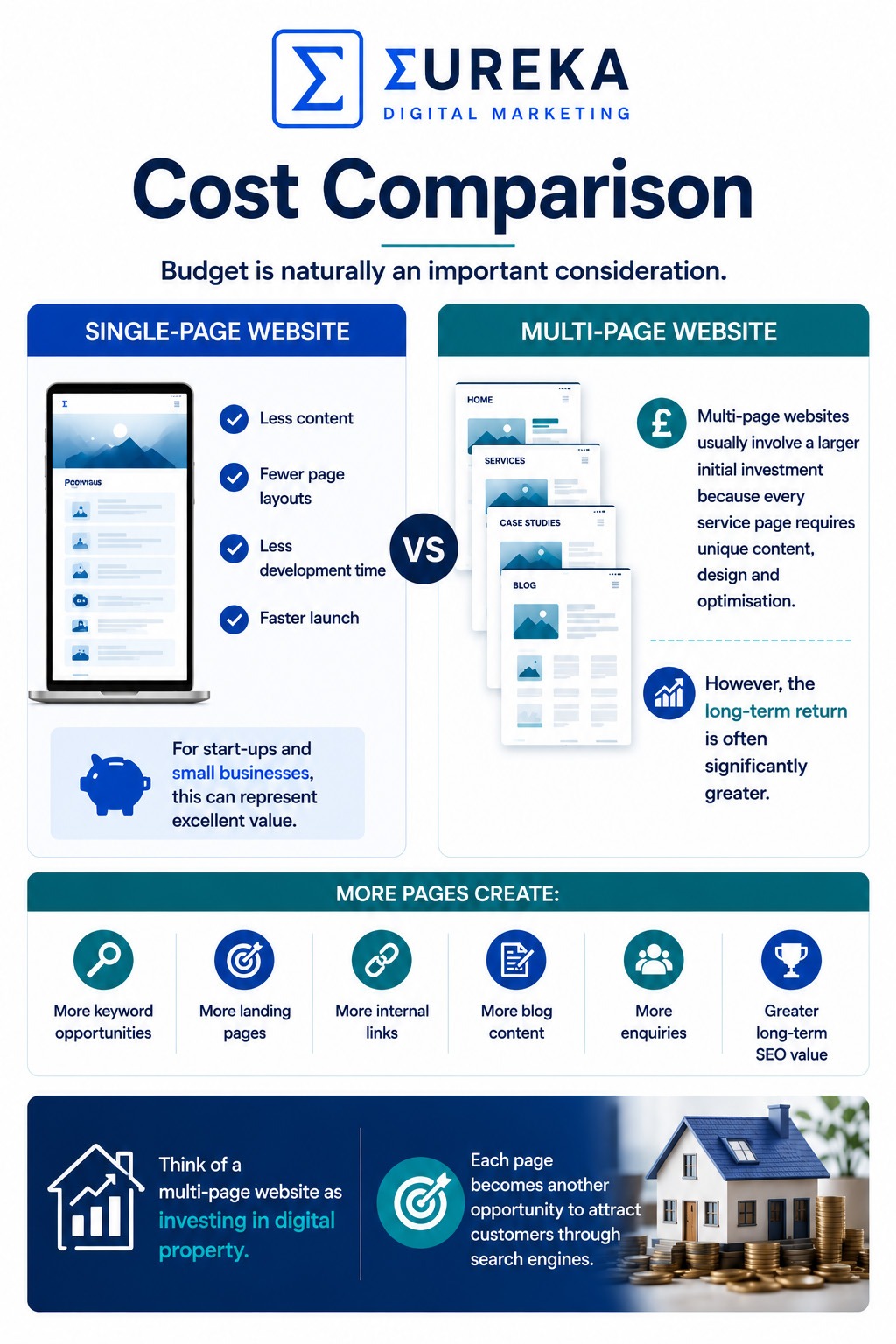
Budget is naturally an important consideration.
Single-page websites generally require:
✔ Less content
✔ Fewer page layouts
✔ Less development time
✔ Faster launch
For start-ups and small businesses, this can represent excellent value.
Multi-page websites usually involve a larger initial investment because every service page requires unique content, design and optimisation.
However, the long-term return is often significantly greater.
More pages create:
- More keyword opportunities
- More landing pages
- More internal links
- More blog content
- More enquiries
- Greater long-term SEO value
Think of a multi-page website as investing in digital property.
Each page becomes another opportunity to attract customers through search engines.
Which Website Structure Delivers the Best Return on Investment?
If you're launching a small business with one service and a limited marketing budget, a professionally designed single-page website can be an excellent starting point.
However, if your objective is to:
- Generate consistent enquiries
- Improve Google rankings
- Publish regular content
- Expand your services
- Build authority within your industry
- Invest in long-term SEO
then a multi-page website is almost always the stronger long-term investment.
Rather than viewing the additional pages as an expense, think of them as individual marketing assets—each capable of attracting visitors, answering customer questions and generating leads independently.
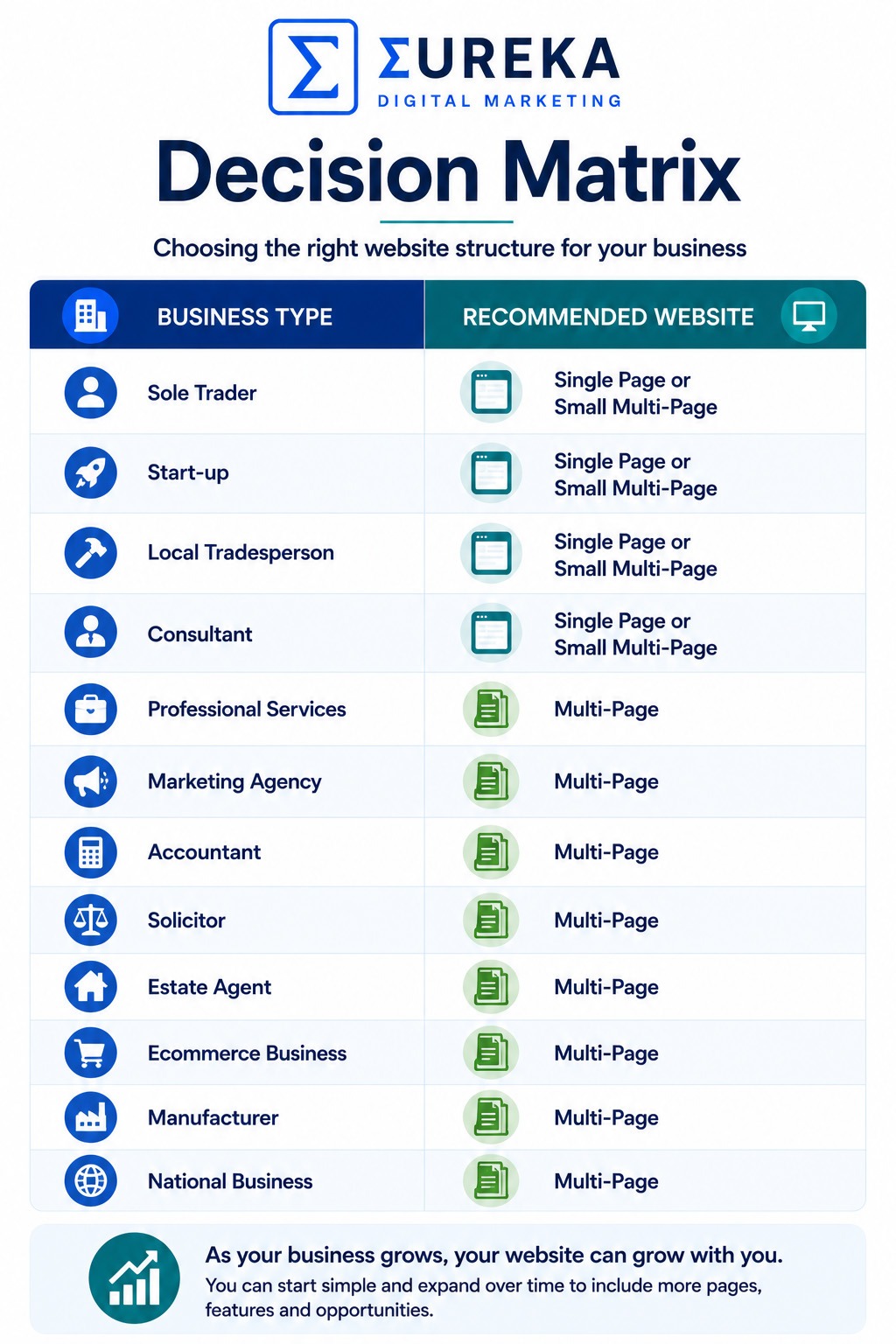
Whether you're starting from scratch or considering redesigning an existing website, choosing the right structure from the outset can save significant time and money in the future.
At Eureka Digital Marketing, we build websites designed not only to look professional, but also to support long-term SEO, improve user experience and generate measurable business growth.
If you're unsure whether a single-page or multi-page website is right for your business, we'd be happy to discuss your goals and recommend the most effective solution.
Get in touch
Let’s Talk About Growing Your Business
Struggling to get found on Google? Send us a few details and we’ll help you understand the best SEO route for your business.. To arrange a meeting, fill the form in below and a member of the team will get in touch with you, alternatively you can book a time slot at a time that suits you by clicking this link, or simply call us on 01276 582169
Tell us a little about your goals and we'll be in touch within one working day.